


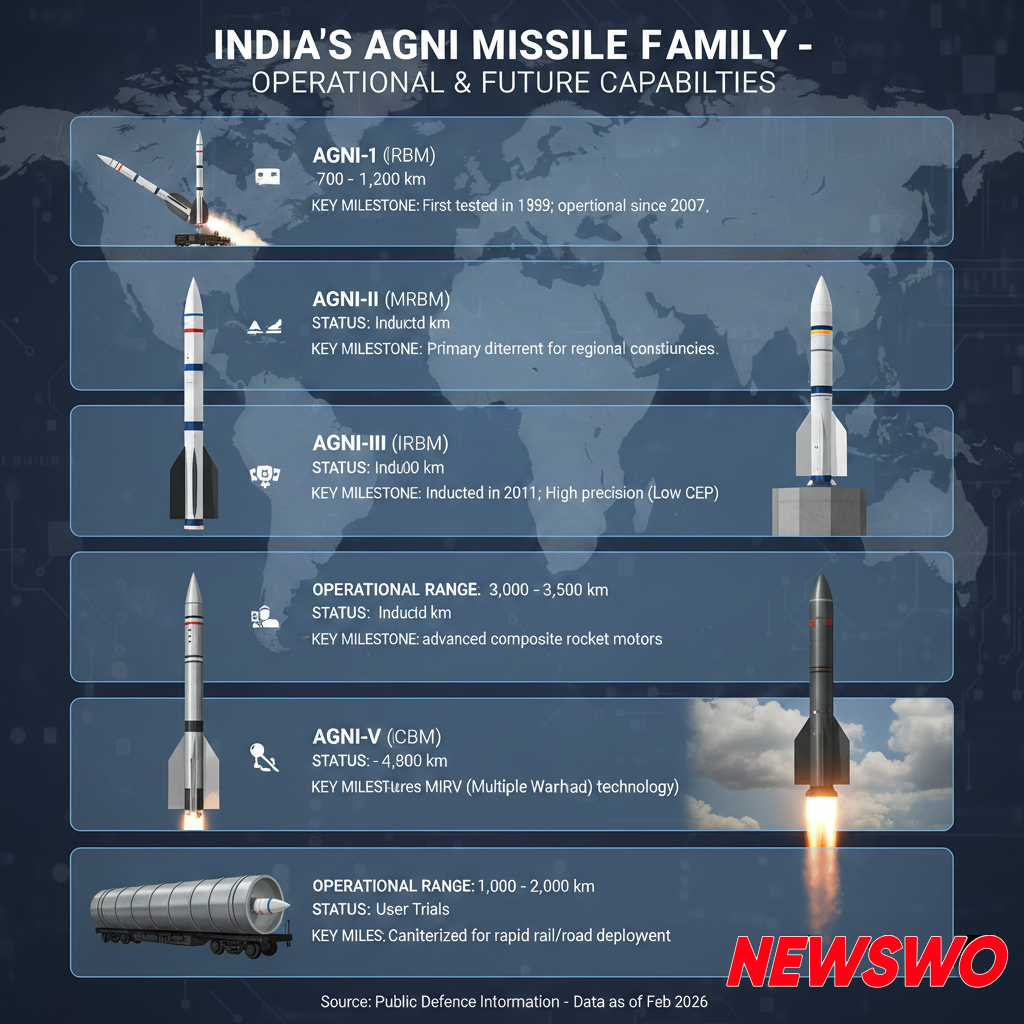
India’s Strategic Forces Command (SFC) successfully test-fired the Intermediate-Range Ballistic Missile (IRBM) Agni-3 from the Integrated Test Range (ITR) here yesterday, validating its operational readiness and cementing its role as a regional deterrent. This routine yet crucial exercise, confirming the 3,000 km missile’s precision and reliability, serves as a timely reminder of India’s robust strategic capabilities. However, this success is merely one facet of a much broader, more ambitious trajectory: India’s rapid advancement into intercontinental reach and Multiple Independently Targetable Re-entry Vehicle (MIRV) technology, designed to future-proof its deterrence against increasingly sophisticated missile defense systems.
Agni-3: The Reliable Pillar of Regional Security
Inducted into service in 2011, the Agni-3 remains a cornerstone of India’s land-based nuclear triad. Its two-stage, solid-fuelled design ensures rapid deployment and survivability, capable of delivering a 1.5-ton payload at Mach 15 with pinpoint accuracy thanks to its advanced ring laser gyroscope-based inertial navigation system. The Agni-3 bridged a critical gap in India’s missile arsenal, providing a robust response capability that ensures a “credible minimum deterrent” within its immediate strategic periphery. Its successful test reaffirms the SFC’s operational readiness and commitment to maintaining a robust and reliable arsenal.
Mission Divyastra: The MIRV Revolution Takes Flight
While the Agni-3 secures regional interests, India has already embarked on a quantum leap in strategic capability with Mission Divyastra. In a groundbreaking test in March 2024, India formally joined an elite group of nations possessing MIRV technology. Unlike conventional missiles that deploy a single warhead, a MIRVed missile—demonstrated with an upgraded Agni-V—can release multiple nuclear warheads, each independently guided to strike different targets hundreds of kilometers apart.
This advancement profoundly alters the strategic landscape:
- Overwhelming Defenses: A single MIRVed missile can saturate and overwhelm enemy Ballistic Missile Defence (BMD) systems with a barrage of real warheads and decoys.
- Enhanced Survivability: It significantly complicates an adversary’s ability to conduct a first strike, as even a few surviving MIRVed missiles can guarantee devastating retaliation.
- Precision and Autonomy: Equipped with indigenous avionics, high-accuracy sensor packages, and advanced onboard computing, these re-entry vehicles achieve exceptional precision, hitting targets within single-digit meter accuracy.
The Agni-VI: India’s True Intercontinental Ambition
Looking further ahead, the Agni-VI, currently under advanced development, represents India’s most formidable strategic asset and its definitive move into true intercontinental ballistic missile (ICBM) capabilities. Designed to surpass the Agni-V’s impressive range, the Agni-VI aims for a striking distance of 10,000 to 12,000 km.
Key projected features and strategic impact of the Agni-VI include:
- Global Reach: A 12,000 km range would enable India to target almost any major city or strategic location across the globe from its home territory, fundamentally altering its geopolitical standing.
- Multiple Warhead Capacity: Expected to carry up to 10 MIRVs, the Agni-VI will maximize its ability to penetrate and bypass even the most advanced missile defense architectures.
- Triad Completion: A critical objective for the Agni-VI program is the development of a submarine-launched (SLBM) variant, completing the most “survivable” leg of India’s nuclear triad. This virtually undetectable second-strike platform ensures ultimate deterrence.
- Maneuverable Warheads (MaRV): Future iterations are anticipated to incorporate MaRV technology, allowing warheads to perform evasive maneuvers during their terminal descent, further enhancing their ability to defeat interceptor missiles.
The successful Agni-3 test is a testament to India’s current strategic strength. However, the concurrent development of MIRV technology and the Agni-VI ICBM signals a clear intent: to not just maintain but aggressively advance India’s position as a formidable, future-proofed nuclear power on the global stage.